

Child & teenager therapy
Children and teenagers feel things deeply.
Sometimes they just need someone who knows how to listen.
At Affiniti+, we work with children and teens from early childhood through to late adolescence. We help them make sense of what they're feeling — and give them the tools to move forwards. We know that seeking help for your child is never a small decision. Our role is to make the process feel as straightforward, warm and unhurried as possible — for you and for them.
Is therapy for my child and teen?
Children and teenagers experience the full range of emotions that adults do — but often without the language or context to make sense of them. That gap between what they feel and what they can express is where difficulties can take root.
Therapy can help your child process anxiety, low mood, difficult experiences or painful emotions in a safe and supported environment. It can also help them develop coping strategies, rebuild confidence and strengthen the relationships that matter most to them.
You don't need to wait until things reach a crisis point. If something feels wrong — if your child seems withdrawn, distressed, stuck or unlike themselves — it may be worth talking to someone.
Therapy is equally valuable for young people facing transitions: starting secondary school, exam pressure, identity questions, friendship difficulties or the challenges that can come with a neurodevelopmental diagnosis.

We listen
What does a session involve?
Before any therapy begins, we'll meet for an initial assessment. For children, this will typically involve a session with parents or carers, and a separate or joint session with the child, depending on their age and what feels right. This gives us the chance to understand what's brought you to us, and to answer any questions you have.
From there, we'll draw up a personal treatment plan together — outlining the approach, the goals and roughly how often we'll meet. We review this regularly so the work stays relevant as your child grows and changes.
Sessions for children and young people look different depending on age. For younger children, therapy will typically involve play, drawing, stories and creative activities alongside conversation. For teenagers, sessions will be more talk-based, though we always follow the young person's lead.
Parents and carers are an important part of the process. We'll involve you at every appropriate stage — sharing progress, discussing strategies you can use at home, and making sure you feel informed and supported throughout.
Sessions usually last between 30 and 50 minutes. They can take place in person at our Woolwich clinic or online, depending on what works best for your family. For primary-school-aged children, we generally prefer in-person sessions where possible.

We hear
What is your approach?
We don't believe in a one-size-fits-all approach to children and young people's therapy. Every child and teenager is different — in their temperament, their background, their strengths and the challenges they're facing. Our job is to meet them where they are.
At Affiniti+, we draw on a range of evidence-based approaches rather than working from a single model. This allows us to adapt our methods to suit the individual child, and to change direction if something isn't working.
We take the time to understand not just the presenting difficulty, but the full picture: family dynamics, school environment, cultural background, and any earlier experiences that may be relevant. We are respectful of each family's values, traditions and expectations.
We see children and teenagers as capable and resilient. Our aim is to work with that resilience — helping young people build a stronger, more confident relationship with themselves and the people around them.
Throughout the process, we work in genuine partnership with parents and carers. You are not peripheral to the therapy: you are central to it.

We help
Who do we see?
We work with children and young people across a wide range of difficulties, including:
Anxiety, worry and fears
Low mood and depression
School-related stress or difficulties
Friendship and relationship challenges
Family transitions (separation, bereavement, new siblings, moving home)
Trauma and adverse childhood experiences
Self-esteem and identity
Thoughts of self-harm
Emotional difficulties related to neurodevelopmental conditions (ADHD, autism)
Disordered eating
Selective mutism
Do you specialise in any particular areas?
The approaches we draw on include:
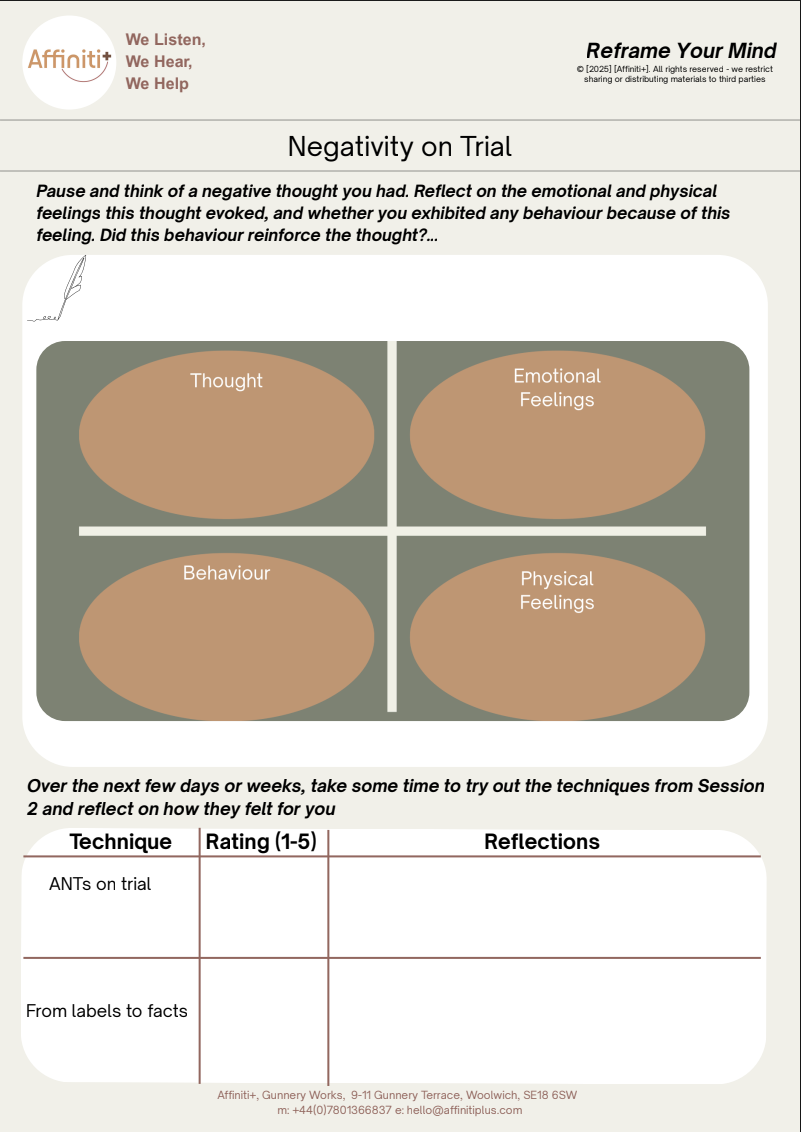
Cognitive behavioural therapy (CBT)
Play therapy
Narrative therapy
Integrated psychotherapy
Solution-focused brief therapy
Cognitive analytical therapy (CAT)
Motivational interviewing

Questions, guidance or book an appointment
You don't need to know exactly what to ask for.
If you're unsure whether we can help your child or teenager, or you'd like to find out more before committing to an appointment, contact us for a confidential conversation.
Confidential We aim to reply within 48 hours
Safeguarding and urgent support
Affiniti+ is not an emergency service and does not work with individuals in crisis. If urgent support is required, contact your GP, attend your local emergency department or call 999.
Read our safeguarding policy and support contacts